
The DWP benefit fraud crackdown in 2026 uses stronger data checks, bank eligibility verification and investigation powers to identify fraud and incorrect benefit payments.
The new Eligibility Verification Measure allows financial institutions to provide limited information when certain benefit eligibility indicators are met. A bank flag does not automatically mean fraud has been committed.
Anyone who suspects deliberate benefit fraud can report benefit fraud directly to the DWP through GOV.UK, and reports can be made anonymously.
Why Was The DWP Benefit Fraud Crackdown Introduced?
Benefit fraud has been a long-running problem, but the government’s focus has increased as incorrect payments have remained at historically high levels.
For the financial year ending 2026, 3.2% of total benefit expenditure was estimated to have been overpaid because of fraud and error, equal to approximately £9.9 billion. After recoveries, the estimated net loss to the DWP was £8.6 billion.
The crackdown is therefore aimed at identifying problems earlier rather than allowing incorrect payments to continue for months or years.
The DWP has also moved towards greater use of data matching and targeted checking. The latest DWP bank account monitoring rules allow financial institutions to apply eligibility indicators to certain benefit-receiving accounts without giving DWP staff unrestricted access to someone’s banking activity.
The approach is intended to deal with both deliberate fraud and genuine mistakes. This distinction matters because a person making an error on a claim is not automatically considered to have committed benefit fraud.
What Improvements Have Been Seen Since Fraud Checks Were Strengthened?
There has been some improvement in the overall rate of incorrect benefit payments.
In the financial year ending 2024, the total overpayment rate was 3.6%. It fell to 3.3% in 2024/25 and then to 3.2% in 2025/26. However, the monetary amount remains substantial because overall benefit expenditure has increased.
More targeted reviews have also enabled the DWP to identify incorrect payments before they continue for longer periods.
The Enhanced Review Team Universal Credit process is one example. It applies more detailed verification where a claim has been identified as having an increased risk of incorrectness or fraud. Being selected for an enhanced review does not itself mean fraud has been proven.
Better data matching can also make it easier to identify underpayments and official mistakes. That is important because the government’s fraud and error programme is not solely concerned with finding money to recover from claimants. It is also designed to improve the accuracy of benefit awards.
Despite these improvements, almost £10 billion of estimated overpayments in 2025/26 shows why the DWP continues to expand its prevention and verification work.
What Changed Under The DWP Benefit Fraud Crackdown In 2026?
The major 2026 development is the Eligibility Verification Measure, commonly shortened to EVM.
Under EVM, authorised DWP staff can issue an Eligibility Verification Notice to a bank or another qualifying financial institution. The institution applies specified eligibility indicators to relevant accounts and returns permitted information where those indicators are met.
Current guidance places three benefits within the initial scope:
- Universal Credit: Savings, capital and other financial circumstances can affect entitlement
- Pension Credit: Income and capital can influence how much someone receives
- New Style ESA: Relevant eligibility conditions can be checked through the measure
The DWP bank detail checks for Universal Credit, Pension Credit and ESA are therefore targeted at particular eligibility conditions rather than providing unrestricted access to every transaction in a claimant’s account.
Banks may provide information such as account-holder details, account numbers, sort codes, balances and information relating to qualifying linked accounts.
There are important limitations. EVM does not allow the DWP to log into someone’s online banking, continuously watch an account or obtain full bank statements through the measure. The system is intended to identify accounts that may require further checking.
A match also does not prove fraud.
The DWP’s own code states that information returned through an Eligibility Verification Notice does not in itself imply fraud, wrongdoing or even that an error has occurred. DWP staff must decide whether further enquiries are justified.
What Different Types Of Benefit Fraud Are There?
Benefit fraud generally involves intentionally claiming money that a person knows they are not entitled to receive.
Official guidance gives examples such as deliberately failing to report a change in circumstances or knowingly supplying false information.
Different forms of benefit fraud can include:
- Undeclared Income Or Employment: Deliberately hiding earnings or paid work that affects benefit entitlement
- Undeclared Savings Or Capital: Intentionally failing to disclose savings, investments or other capital relevant to a means-tested benefit
- Living With A Partner Without Reporting It: Deliberately continuing a claim using household circumstances that are no longer correct
- False Housing Information: Providing false rent, tenancy or address information to obtain payments
- Identity Fraud: Making a claim using another person’s identity or fabricated personal information
- False Disability Information: Deliberately providing dishonest information about circumstances relevant to entitlement
- Organised Benefit Fraud: Coordinated activity involving false identities, fabricated claims, forged evidence or multiple people
Not every change involving employment amounts to fraud. The rules surrounding work can depend heavily on the benefit involved. For example, separate 2026 reforms introduced protections when some disabled benefit claimants try work or volunteering, although other changes in income or circumstances may still need to be reported.
Intent is an important distinction. A claimant who accidentally supplies incorrect information may still have an overpayment to repay, but that does not automatically mean the case is criminal fraud.
How Does The DWP Check Benefit Eligibility And Bank Information?
The DWP can use several sources of information when checking whether a claim remains correct.
These can include information already held within the benefits system, employment and earnings data, claim reviews, financial information obtained through authorised processes and information received from other agencies.
Under EVM, the process is more structured.
A financial institution applies eligibility indicators specified by the DWP to relevant accounts. Where an account meets an indicator, permitted information can be returned to the department.
The DWP then considers that information alongside what it already knows about the claim.
A typical process can involve:
- Eligibility Indicator Identified: An account meets a condition specified in an Eligibility Verification Notice
- Information Sent To DWP: The financial institution supplies only the information permitted under the measure
- Claim Reviewed: DWP staff compare the information with the claimant’s existing records
- Evidence Requested: The claimant may be asked to supply documents or explain the circumstances
- Human Decision Made: DWP staff decide whether the claim is correct or whether further action is required
The system does not allow the bank itself to decide that a person has committed fraud or should lose their benefit.
DWP checks can compare benefit records with permitted financial information and other eligibility data.
What Can Trigger A DWP Benefit Fraud Investigation?
A benefit fraud investigation can begin in several ways. There is no single trigger that automatically proves wrongdoing.
Potential reasons for closer investigation include:
- Unreported Earnings: Employment or other income appears inconsistent with information supplied to the DWP
- Undeclared Capital: Financial information suggests savings or investments may be different from those declared
- Household Changes: Evidence suggests someone may be living with a partner while claiming on a different basis
- Housing Information: Rent, tenancy or address details appear inconsistent
- Information From Another Agency: Government records do not match the information on a benefit claim
- Eligibility Check Findings: Information obtained through a lawful verification process requires further investigation
- Public Fraud Report: Someone reports suspected fraud to the DWP
- False Documents: Identification, tenancy records, payslips or other evidence appear to have been deliberately altered or fabricated
A DWP review should not automatically be treated as a fraud investigation. Routine checking, compliance activity, enhanced reviews and formal criminal fraud investigations are different stages with different purposes.
How Can Someone Report Benefit Fraud To The DWP?
Suspected benefit fraud can be reported online, by telephone or by post.
A report can include information such as the person’s name, address and the type of suspected fraud. Reporters are encouraged to provide information they genuinely know rather than attempting to investigate the individual themselves.
People should not follow someone, access private information or put themselves at risk in an attempt to gather additional evidence.
The DWP also advises that the same allegation should only be reported once. Sending repeated versions of the same report does not make the allegation stronger.
Is A Benefit Fraud Report Anonymous?
Yes. The official DWP reporting service states that all benefit fraud reports are anonymous.
A person making a report does not have to provide their name or contact details. The individual being reported is not given the identity of the person who submitted the allegation.
However, anonymity works both ways when it comes to the outcome.
The DWP will not normally tell the reporter what eventually happened. Details about another person’s benefit claim and any investigation remain confidential.
An anonymous report also does not mean the allegation is automatically accepted as true. The information still has to be assessed before the DWP decides whether further checking is appropriate.
What Happens After Benefit Fraud Is Reported?
Once a fraud allegation reaches the DWP, benefits are not automatically stopped.
The department first examines the information provided and considers whether it gives a reasonable basis for further enquiries.
The process may involve the following stages:
- Initial Assessment: The allegation is examined to determine whether it contains relevant information
- Record Checks: Existing benefit information may be checked against the details supplied
- Further Verification: Additional government or financial information may be considered where there is a lawful basis to obtain it
- Claimant Contact: The person may be asked to provide evidence or clarify their circumstances
- Formal Investigation: Cases involving stronger evidence of deliberate fraud may progress to specialist investigators
- Interview Under Caution: A claimant suspected of criminal fraud may be invited to a formal recorded interview
- Final Decision: The DWP may take no action, correct the benefit award, recover an overpayment, impose an applicable penalty or refer a serious case for prosecution
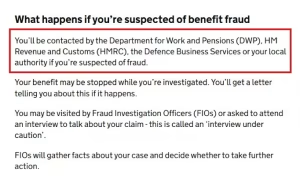
DWP assesses the report, checks records and may request evidence or begin a formal investigation.
Official guidance makes clear that sometimes nothing happens after a report because the person has already declared the relevant circumstances or because the information reported does not actually affect their benefit entitlement.
This is an important safeguard against treating anonymous accusations as evidence of guilt.
What Happens If A Bank Account Is Flagged?
A bank account matching an EVM eligibility indicator does not mean the claimant has committed benefit fraud.
The DWP must first review the information.
For example, a balance that appears high may include money that has already been reported, jointly owned funds or capital that may be disregarded under benefit rules.
The claimant could then be asked for documents such as bank statements or evidence explaining where money came from.
A bank flag can therefore result in:
- No Further Action: Existing records adequately explain the information
- Request For Evidence: More information is needed before entitlement can be confirmed
- Benefit Correction: The award is changed because entitlement was incorrect
- Overpayment Recovery: Money paid incorrectly may need to be repaid
- Further Investigation: Evidence indicating deliberate dishonesty may lead to fraud enquiries
The DWP Bank Account Checks 2026 process still requires human review before decisions affecting entitlement are made.
What New Powers And Penalties Apply In 2026?
The government’s anti-fraud reforms have strengthened the DWP’s ability to verify eligibility, obtain information and recover certain debts.
These powers should not all be treated as the same thing. EVM is primarily an eligibility-verification mechanism, while fraud investigations and debt recovery operate through separate legal processes.
Where deliberate fraud is established, possible consequences can include:
- Overpayment Recovery: Benefits received without entitlement may have to be repaid
- Administrative Penalty: Certain cases can result in a financial penalty as an alternative to prosecution
- Loss Of Benefit Penalty: Some fraud offences can result in benefit payments being reduced or restricted
- Criminal Prosecution: Serious cases may be referred for prosecution
- Further Financial Recovery: Additional action may follow where criminal proceeds or unpaid debts are involved
DWP’s penalties policy was updated in June 2026 and confirms that the department can use different enforcement responses depending on whether a case involves suspected fraud or claimant error.
The new framework also includes stronger debt-recovery options. These should not be confused with routine bank eligibility checks. A bank flag does not allow money to disappear automatically from someone’s account.
What Rights And Safeguards Do Claimants Have?
Stronger fraud powers do not remove a claimant’s right to fair decision-making.
The Eligibility Verification Measure contains restrictions on the information financial institutions can provide, and DWP staff remain responsible for decisions affecting entitlement.
Important protections include:
- Human Review: A bank or automated system does not make the final benefit decision
- Limited Information: EVM does not provide unrestricted access to bank accounts
- Independent Oversight: The operation of the eligibility-verification powers is subject to independent review
- Data Protection: Information must be handled in accordance with relevant data-protection requirements
- Right To Explain: A claimant may be asked to supply evidence explaining an apparent discrepancy
- Mandatory Reconsideration: Claimants can ask for qualifying benefit decisions to be reconsidered if they believe the decision is wrong
The official EVM code specifically confirms that the measure does not remove the existing right to request a Mandatory Reconsideration.
What Should Someone Do If The DWP Contacts Them?
A genuine DWP request should be taken seriously, but being contacted does not automatically mean fraud has been established.
The claimant should first understand what type of contact has been received. A standard Universal Credit appointment, routine claim review, enhanced review and Interview Under Caution are not the same thing.
Someone contacted by the DWP should:
- Read the Request Carefully: Identify what information is required and when it must be provided
- Check the Contact Is Genuine: Use official contact details if there is uncertainty about a message or call
- Provide Accurate Information: Answers and supporting documents should reflect the claimant’s actual circumstances
- Keep Copies: Retain letters, journal messages, bank statements and other evidence supplied
- Explain Problems Early: Contact the DWP where evidence cannot reasonably be provided by the deadline
- Seek Professional Advice: Legal or welfare-rights advice may be appropriate in serious fraud investigations or Interviews Under Caution
- Use Challenge Rights: Request reconsideration or appeal where the law permits and the claimant believes a decision is wrong
Routine responsibilities also continue while a claim is being managed. For example, there can be legitimate reasons for missing a Universal Credit appointment, but claimants should notify Universal Credit promptly and provide an explanation rather than simply ignoring an appointment.
Conclusion
The DWP benefit fraud crackdown in 2026 represents a significant shift towards earlier verification, better data matching and stronger action where deliberate fraud or incorrect payments are identified.
The Eligibility Verification Measure is one of the biggest changes. Financial institutions can be required to apply eligibility indicators to accounts connected with Universal Credit, Pension Credit and New Style ESA and provide limited information where those indicators are met.
However, stronger checking does not mean every claimant is treated as a fraud suspect.
A bank flag is not proof of fraud. An anonymous allegation is not proof of fraud. A Universal Credit review is not proof of fraud. Each can lead to further checks, but evidence and human decision-making are still required.
For claimants, the safest approach is to keep information accurate, report relevant changes promptly, retain useful records and respond to genuine DWP requests.
For members of the public reporting suspected fraud, the official service allows allegations to be made anonymously without attempting to investigate the person personally.
Frequently Asked Questions
Can The DWP Check A Bank Account Without Permission?
Financial institutions can be required to comply with a valid Eligibility Verification Notice without obtaining separate consent from the claimant. The information that can be supplied remains legally restricted.
Can The DWP See What Someone Spends Their Money On?
EVM does not give DWP staff unrestricted access to someone’s spending or online banking. Full transaction histories and real-time account monitoring are not part of the measure.
Is Reporting Benefit Fraud Anonymous?
Yes. The official DWP reporting service states that benefit fraud reports are anonymous, and a reporter does not have to provide their name or contact details.
How Long Does A DWP Benefit Fraud Investigation Take?
There is no single fixed timeframe. The length depends on the complexity of the allegation, information available, evidence required and whether formal enforcement action becomes necessary.
Can Benefits Be Stopped During A Fraud Investigation?
They can be stopped in some circumstances, but this is not automatic in every investigation. The claimant should receive communication explaining any decision affecting their benefit.
Can The DWP Take Money Directly From A Bank Account?
Separate debt-recovery powers can allow qualifying DWP debts to be recovered from accounts in certain circumstances. These powers are different from ordinary EVM eligibility checks.
Does A Bank Flag Mean Someone Has Committed Benefit Fraud?
No. A bank match only identifies information that may require checking. DWP staff must consider the claimant’s circumstances and evidence before deciding whether anything is wrong.