
The DWP Cold Weather Payment scheme for winter 2026–27 starts on 1 November 2026 and runs until 31 March 2027.
Eligible households can receive £25 for each seven-day period when the average temperature in their area is recorded as, or forecast to be, 0°C or below.
As of 29 October 2026, no 2026–27 Cold Weather Payment areas have been triggered because the new season has not yet started. GOV.UK says the postcode-checking service will become available in November 2026.
This means postcode lists from January or February 2026 relate to the previous 2025–26 winter and should not be treated as confirmation that the same areas will receive a payment this winter.
Claims about a much larger lump-sum payment should also be treated separately.
The current Cold Weather Payment remains £25 per qualifying cold period, rather than the amount sometimes described online as a £140 Cold Weather Payment.
Which Areas Are Eligible For Cold Weather Payments Right Now?
There are currently no confirmed 2026–27 triggered areas because the payment season does not begin until 1 November 2026.
Once the scheme begins, areas in England and Wales can trigger a payment when their linked weather station records or forecasts an average temperature of 0°C or below over seven consecutive days.
Northern Ireland operates a separate Cold Weather Payment system with its own postcode checker. Scotland no longer participates in the DWP Cold Weather Payment scheme.
The important distinction is that a postcode does not qualify for the entire winter. It becomes a payment area only when its linked weather station meets the temperature test during a particular seven-day period.
Current Position On 29 October 2026
Detail 2026–27 Position
Scheme Start Date 1 November 2026
Scheme End Date 31 March 2027
Payment Per Trigger £25
Temperature Threshold Average of 0°C or below
Qualifying Period Seven Consecutive Days
Current Triggered Areas None Yet
Application Required No, If Eligible
Postcode Checker Due To Be Available In November 2026
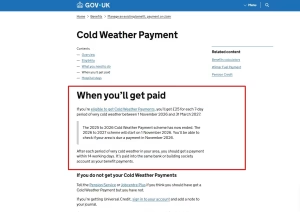
GOV.UK confirms that the 2025–26 scheme has ended and the 2026–27 Cold Weather Payment season begins on 1 November 2026.
How Do DWP Cold Weather Payments Work?
Cold Weather Payments are designed to help eligible households meet extra heating costs during unusually cold periods.
The Department for Work and Pensions works with the Met Office to determine whether particular locations have experienced sufficiently cold conditions.
A payment is triggered when the average temperature over seven consecutive days is recorded as, or forecast to be, 0°C or below. It does not mean the temperature must remain continuously below freezing every hour for an entire week.
The DWP system works broadly as follows:
- Postcode Mapping: Residential postcode districts are assigned to Met Office weather stations
- Daily Monitoring: Average temperatures are monitored throughout the Cold Weather Payment season
- Seven-Day Assessment: Recorded and forecast temperatures are used to calculate the relevant seven-day average
- Payment Trigger: A weather station triggers when the seven-day average meets the 0°C threshold
- Automatic Processing: Eligible people within the affected postcode coverage area are identified
- Payment Issued: £25 is paid for each qualifying period
DWP’s previous methodology used 71 weather stations across England and Wales.
When deciding which station should represent a postcode district, factors such as topography, distance, built-up areas and long-term winter temperatures are considered.
This explains why two nearby towns can sometimes receive different results. Their postcodes may be connected to different weather stations with different recorded or forecast conditions.
Who Is Eligible For A DWP Cold Weather Payment?
Living in an area that experiences freezing weather is only one part of the test. You must also satisfy the benefit eligibility conditions.
For the current scheme, GOV.UK lists the following main qualifying categories.
- Pension Credit: People receiving Pension Credit will usually qualify
- Income-Related Employment And Support Allowance: Eligibility can depend on the claimant’s ESA group, disability-related premiums or whether a young or disabled child lives with them
- Universal Credit: Additional rules normally apply relating to employment, limited capability for work, disability or having a child under five
- Support For Mortgage Interest: Certain additional circumstances must normally apply
Universal Credit claimants are generally eligible where neither they nor their partner is employed or gainfully self-employed and qualifying health, disability or child conditions are met.
There is an important exception where the Universal Credit award includes a disabled child amount. GOV.UK says employment status does not prevent Cold Weather Payment eligibility in that situation.
The benefit landscape has changed significantly as older means-tested benefits have moved towards Universal Credit.
The wider DWP benefits closure changes in 2026 are therefore relevant when comparing today’s eligibility rules with older Cold Weather Payment articles.
Older households receiving Pension Credit may also want to distinguish Cold Weather Payments from other pension-related changes, including the continuing DWP State Pension age change in 2026.
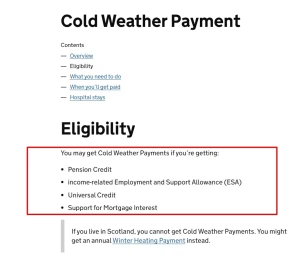
GOV.UK lists the current benefits and additional circumstances that can qualify a household for Cold Weather Payments.
Does Everyone In A Triggered Postcode Get £25?
No. A weather trigger does not mean every household in the postcode receives £25.
Two separate conditions need to be satisfied.
First, your postcode must fall within the coverage area of a weather station that has triggered a Cold Weather Payment.
Second, you must personally satisfy the relevant benefit and eligibility rules.
For example, two neighbours could live within the same triggered postcode.
One may receive Universal Credit and meet the Cold Weather Payment conditions, while the other may not receive any qualifying benefit. Only the eligible household would receive the payment.
The payment is therefore targeted rather than a universal payment made to everyone experiencing cold weather.
It is also normally paid automatically. Eligible households should not have to submit a new Cold Weather Payment application each time temperatures fall.
How Does DWP Decide Which Postcodes Qualify?
Cold Weather Payments are based on postcode districts linked to weather stations, rather than temperatures measured outside individual homes.
DWP’s methodology explains that the Met Office considers several factors when matching a postcode district to a weather station, including:
- Distance From The Weather Station
- Local Topography
- Extent Of Built-Up Areas
- Representative Winter Climate
- Long-Term Average Winter Temperatures
Once DWP agrees the postcode-to-weather-station mapping for a season, that mapping is generally used throughout the winter.
Every day, the Met Office calculates average temperatures and looks at both recorded conditions and forecasts.
A trigger occurs when the relevant seven-day average reaches 0°C or below and the period does not simply overlap with another period for which a payment has already been triggered.
This arrangement can create situations where one postcode qualifies but another nearby postcode does not.
A person’s own thermometer, local weather app or overnight minimum temperature therefore cannot confirm entitlement by itself.
Full List Of DWP Cold Weather Payment Areas And Postcodes
2026–27 Cold Weather Payment Areas
No postcode areas have yet triggered for winter 2026–27 as of 29 October 2026.
The season begins on 1 November 2026, so this section should be updated whenever DWP confirms new weather triggers.
Do not replace the statement above with postcode lists from January 2026. Those relate to the previous winter.
Previous Winter Postcode Reference
The following table preserves all unique postcode districts already contained in the previous version of this article, grouped by area so readers can check historical coverage more easily.
These are not automatically eligible for winter 2026–27 and should be treated as historical information until a new trigger is confirmed.
Region Or County Historical Postcode Districts
Barnsley S36
Bedford Borough MK40, MK41, MK42, MK43, MK44
Bedfordshire LU1, LU2, LU3, LU4
Berkshire RG1, RG2, RG4, RG30, RG31
Blaenau Gwent NP13, NP22, NP23
Bracknell Forest GU47, RG12, RG42
Bradford BD2, BD3, BD4, BD5, BD6, BD7, BD8, BD9, BD10, BD11, BD12, BD13, BD14, BD15, LS29
Buckinghamshire HP5, HP6, HP7, HP8, HP9, HP10, HP11, HP12, HP13, HP14, HP15, HP16, HP17, HP18, HP19, HP20, HP21, HP22, HP27, MK18, SL7, SL8, SL9
Caerphilly CF81, CF82, CF83, NP11, NP12, NP24
Calderdale HX1, HX2, HX3, HX4, HX5, HX6, HX7, OL14
Cambridgeshire CB1, CB2, CB3, CB4, CB5, CB6, CB7, CB8, CB21, CB22, CB23, CB24, CB25, PE13, PE19, SG8
Central Bedfordshire LU5, LU6, LU7, MK45, SG15, SG16, SG17, SG18, SG19
County Durham DH1, DH6, DH7, DH8, DH9, DL4, DL5, DL12, DL13, DL14, DL15, DL16, DL17, TS21, TS28, TS29
Derbyshire DE4, DE6, DE45, S32, S33, SK13, SK17, SK22, SK23
East Sussex RH18, TN5, TN6, TN7, TN19, TN20, TN22
Essex CB10, CB11, CM1, CM2, CM3, CM4, CM5, CM6, CM7, CM8, CM9, CM11, CM12, CM13, CM14, CM15, CM16, CM17, CM18, CM19, CM20, CM22, CM24, CM77, CO1, CO2, CO3, CO4, CO5, CO6, CO7, CO8, CO9, CO11, CO12, CO13, CO14, CO15, CO16, RM4
Greater London TN16
Hampshire GU11, GU14, GU17, GU30, GU31, GU32, GU33, GU34, GU35, GU46, GU51, GU52, RG21, RG22, RG23, RG24, RG25, RG26, RG27, RG29, SO24
Hertfordshire AL1, AL2, AL3, AL4, AL5, AL6, AL7, AL8, AL9, AL10, CM21, CM23, EN6, HP1, HP2, HP3, HP4, HP23, SG1, SG2, SG3, SG4, SG5, SG6, SG7, SG9, SG10, SG11, SG12, SG13, SG14, WD3, WD4, WD5, WD6, WD7, WD17, WD18, WD19, WD23, WD24, WD25
Kent ME6, ME14, ME15, ME16, ME17, ME18, ME19, ME20, TN1, TN2, TN3, TN4, TN8, TN9, TN10, TN11, TN12, TN13, TN14, TN15, TN17, TN18, TN27
Kirklees HD3, HD7, HD8, HD9
Lancashire BB4, BB8, BB9, BB10, BB11, BB12, BB18, OL13
Leeds LS21
Lincolnshire PE12
Merthyr Tydfil CF46, CF47, CF48
Milton Keynes MK1, MK2, MK3, MK4, MK5, MK6, MK7, MK8, MK9, MK10, MK11, MK12, MK13, MK14, MK15, MK16, MK17, MK46
Norfolk IP20, IP24, IP25, IP26, NR1, NR2, NR3, NR4, NR5, NR6, NR7, NR8, NR9, NR10, NR11, NR12, NR13, NR14, NR15, NR16, NR17, NR18, NR19, NR20, NR21, NR22, NR23, NR24, NR25, NR26, NR27, NR28, NR29, NR30, NR31, PE14, PE30, PE31, PE32, PE33, PE34, PE35, PE36, PE37, PE38
North Yorkshire BD23, BD24, DL8, DL11
Northamptonshire MK19, NN1, NN2, NN3, NN4, NN5, NN6, NN7, NN8, NN9, NN10, NN11, NN12, NN13, NN29
Northumberland NE18, NE20, NE44, NE45, NE46
Oxfordshire OX9, OX10, OX33, OX39, OX44, OX49, RG8, RG9
Powys LD3
Rhondda Cynon Taf CF37, CF38, CF39, CF40, CF41, CF42, CF43, CF44, CF45
Shropshire SY10, SY15
Slough SL1, SL2
Staffordshire ST8, ST9, ST10, ST11, ST13
Suffolk CB9, CO10, IP1, IP2, IP3, IP4, IP5, IP6, IP7, IP8, IP9, IP10, IP11, IP12, IP13, IP14, IP15, IP16, IP17, IP18, IP19, IP21, IP22, IP23, IP27, IP28, IP29, IP30, IP31, IP32, IP33, NR32, NR33, NR34, NR35
Surrey GU1, GU2, GU3, GU4, GU5, GU6, GU7, GU8, GU9, GU10, GU12, GU15, GU16, GU18, GU19, GU20, GU21, GU22, GU23, GU24, GU25, GU26, GU27, RH1, RH2, RH3, RH4, RH5, RH6, RH7, RH8, RH9
Torfaen NP4, NP44
Wales LL20, LL21, LL23, SY16, SY17, SY19, SY21, SY22
West Berkshire RG7, RG14, RG18, RG19, RG20
West Sussex BN5, BN6, BN44, GU28, GU29, RH10, RH11, RH12, RH13, RH14, RH15, RH16, RH17, RH19, RH20
West Yorkshire BD1, BD16, BD17, BD18, BD20, BD21, BD22
Windsor And Maidenhead SL4, SL5, SL6
Wokingham RG5, RG6, RG10, RG40, RG41, RG45
The previous winter produced substantial Cold Weather Payment activity. DWP’s official statistics page was updated through 31 March 2026, showing that trigger data continued to be monitored throughout the full season.
For 2026–27, however, readers should rely on the new-season postcode checker once it becomes available rather than assuming a postcode will qualify again because it appeared above.
Northern Ireland Cold Weather Payment Areas
Northern Ireland operates a separate Cold Weather Payment scheme.
Its official checker allows residents to enter a Northern Ireland postcode and determine whether the local area has experienced a qualifying cold-weather period.
The most recent Northern Ireland checker available before the new season still refers to the 1 November 2025 to 31 March 2026 period, so new 2026–27 areas should only be added after the official service updates.
During the previous winter, triggered Northern Ireland postcode districts included areas such as BT24, BT25, BT26, BT30, BT31, BT32, BT33 and BT34. These should not be presented as automatically triggered for winter 2026–27.
How Much Is The Cold Weather Payment And When Is It Paid?
The payment remains £25 for every qualifying seven-day cold period between 1 November 2026 and 31 March 2027.
There is no single-payment limit for the whole winter.
If a postcode experiences separate qualifying periods, an eligible household could receive more than one payment.
For example:
Number Of Qualifying Periods Total Cold Weather Payment
1 £25
2 £50
3 £75
4 £100
A second payment is not created simply because the same days are counted twice. DWP’s methodology is designed to avoid overlapping trigger periods.
Payments should normally arrive within 14 working days after each qualifying cold-weather period and are paid into the same bank or building society account used for the claimant’s qualifying benefit.
Cold Weather Payment should not be confused with other household support. Information about broader help is covered separately in the current Cost Of Living Payment 2026 update.
How To Check If Your Postcode Has Triggered A Payment?
The safest way to check is through the official government postcode service.
For England and Wales, GOV.UK will provide access to the Cold Weather Payment postcode checker once the new winter season is under way.
For Northern Ireland, use the official nidirect Cold Weather Payment checker.
When checking a postcode, remember that the result only tells you whether weather conditions in your area have triggered a payment. It does not independently confirm that you satisfy the benefit rules.
A good checking process is:
- Confirm that the result relates to 2026–27
- Enter your full postcode into the official checker
- Check whether a qualifying weather period has been recorded
- Confirm that you receive an eligible benefit
- Allow up to 14 working days after the qualifying period
- Check the bank account used for your normal benefit
- Contact the appropriate DWP service if the payment remains missing
This is particularly important early in November because search results may still show highly ranked articles containing postcode lists from January or February 2026.
What To Do If You Have Not Received Your Cold Weather Payment?
If the postcode checker confirms a trigger and you believe you satisfy the eligibility conditions, first check whether 14 working days have passed since the qualifying cold period.
If the payment still has not arrived, the action depends on the benefit you receive.
- Pension Credit Claimants: Contact the Pension Service.
- Employment And Support Allowance Claimants: Contact Jobcentre Plus where appropriate.
- Universal Credit Claimants: Sign in to your Universal Credit account and add a note to your journal. If you cannot access an online account, use the Universal Credit helpline.
You should also make sure relevant changes in circumstances have been reported.
For example, GOV.UK says people receiving Universal Credit or income-related ESA need to report certain changes if they have a baby or a child under five comes to live with them.
Failing to update the claim can affect automatic Cold Weather Payment processing.
Do Cold Weather Payments Apply In Scotland?
No. People living in Scotland cannot receive DWP Cold Weather Payments.
Scotland uses Winter Heating Payment instead. Unlike the Cold Weather Payment system in England and Wales, the Scottish payment does not depend on a local seven-day temperature trigger.
For the relevant winter, Social Security Scotland lists a £62 Winter Heating Payment, paid automatically to qualifying people from December and through winter.
The qualifying week for the next Winter Heating Payment is 2 November to 8 November 2026. Eligibility depends on receiving one of the qualifying benefits and satisfying any additional conditions that apply to that benefit.
This is also different from the age-related winter payment system. Pensioners comparing different forms of support should be aware that the Winter Fuel Payment clawback rules for 2026 apply to a separate payment.
Conclusion
The 2026–27 DWP Cold Weather Payment season begins on 1 November 2026, with eligible households receiving £25 for each qualifying seven-day period when the average temperature is recorded or forecast to be 0°C or below.
As of 29 October 2026, there are no current 2026–27 triggered postcode areas.
Postcode lists circulating from January and February 2026 relate to the previous winter and should not be presented as proof that a household will receive money this year.
Once the new postcode checker is active, the most reliable approach is to check your postcode through the official service, confirm that you meet the current benefit rules and then allow up to 14 working days for an automatic payment.
Because DWP links postcode districts to specific weather stations, nearby areas can receive different results.
Being inside a triggered postcode also does not mean every resident receives £25 because individual benefit eligibility still applies.
Frequently Asked Questions
What Postcodes Qualify For Cold Weather Payments?
No postcode districts have yet triggered for winter 2026–27 as of 29 October 2026. The new season starts on 1 November, after which qualifying areas will appear through the official postcode service.
Can Universal Credit Claimants Get Cold Weather Payments?
Yes, but Universal Credit alone does not automatically guarantee payment. Employment status, limited capability for work, young children and disabled-child elements can affect eligibility.
Do I Need To Apply For A Cold Weather Payment?
No. Eligible payments are normally issued automatically when the weather conditions and benefit requirements are satisfied.
Can I Receive More Than One Cold Weather Payment?
Yes. You can receive £25 for each separate qualifying seven-day period during the Cold Weather Payment season.
How Long Does DWP Take To Pay A Cold Weather Payment?
GOV.UK says eligible households should normally receive the money within 14 working days after each qualifying cold-weather period.
Why Has A Nearby Postcode Qualified But Mine Has Not?
Different postcode districts can be linked to different Met Office weather stations. Temperature readings and forecasts can therefore produce different trigger results for neighbouring areas.
Does Scotland Get The £25 Cold Weather Payment?
No. Scotland replaced Cold Weather Payments with Winter Heating Payment, which is paid according to qualifying benefit rules rather than individual local cold-weather triggers.