

As of now, a full-time London Underground Train Operator earns a basic salary of £76,228 per year. A separate Night Tube Train Operator contract paying for 16 hours over two days is worth £34,844 per year.
The current full-time rate follows a 3.6% pay rise effective from 1 April 2026. Another increase is scheduled for April 2027 under the continuing three-year pay agreement, although the final percentage will depend on the Retail Prices Index recorded in February 2027.
Tube drivers also receive benefits such as free travel on the TfL network, pension membership and annual leave. However, overtime should not be treated as a reliable way to increase earnings because Train Operators cannot normally choose to work additional shifts.
How Much Do Tube Drivers Earn in 2026?
The current basic salary for a full-time London Underground Train Operator is £76,228. Unlike a broad national salary estimate, this is the specific 2026 rate for the TfL Train Operator role.
Pay is primarily attached to the position rather than increasing through a long series of experience bands. Once a trainee completes the required programme and qualifies as a Train Operator, the applicable full-time rate is substantially higher than the salaries offered in many other UK transport jobs.
It is important to distinguish between basic salary, overtime and total compensation. The £76,228 figure is the standard annual salary. Employer pension contributions and other employment costs may make TfL’s total cost higher, but those amounts are not all paid directly to the driver.
Full-Time Train Operator Salary
A qualified full-time Train Operator earns £76,228 per year from April 2026. Based on a contracted 35-hour week, this is equivalent to approximately £41.88 per contracted hour before considering annual leave or other benefits.
Drivers work rotating schedules covering early mornings, late evenings, weekends and bank holidays. The salary reflects the safety-critical nature of the job and the need to maintain concentration while following detailed operating procedures.
Night Tube Train Operator Salary
A Night Tube Train Operator working 16 hours over two days earns £34,844 per year. This is a part-time contract and should not be compared directly with the full-time figure without considering the difference in hours.
TfL no longer recruits Night Tube Train Operators as a completely separate workforce in the same way it once did, but the salary category continues to appear in current pay information.
Trainee Tube Driver Pay
There is no reliable universal 2026 trainee figure that should be applied to every vacancy. The frequently repeated £32,375 salary comes from older recruitment information and may not reflect a future TfL campaign.
Applicants should therefore check the salary displayed in the specific vacancy. Training pay, programme length and eligibility requirements can change between recruitment exercises.
Tube Driver Salary Table for 2026
| Role | Annual Salary | Working Arrangement |
|---|---|---|
| Full-Time Train Operator | £76,228 | Contracted 35-hour week |
| Night Tube Train Operator | £34,844 | 16 hours over two days |
| Trainee Train Operator | Varies by vacancy | Training and supervised operation |
The table shows basic salary rather than total employer compensation. Pension contributions, National Insurance and other employment costs should not be added to the salary and presented as money taken home by the driver.
Tube Driver Pay Comparison, New Announcements and Future Plans
Tube driver pay has changed considerably since the figures still shown by many older salary articles. The current agreement also provides a clear route for another increase in 2027.
Tube Driver Salary Comparison for 2025, 2026 and 2027
| Pay Year | Full-Time Salary | Position |
|---|---|---|
| 2025 | About £73,579 | After the 3.4% award from April 2025 |
| 2026 | £76,228 | After the 3.6% award from April 2026 |
| 2027 | At least approximately £78,134 | Indicative minimum based on a 2.5% rise |
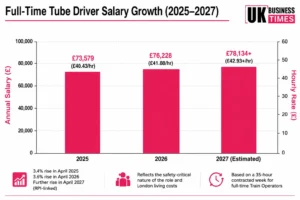
The 2027 figure is not the confirmed final salary. The actual award will equal February 2027 RPI plus 0.2 percentage points, with a minimum increase of 2.5%. If the relevant RPI figure produces a higher percentage, the salary will rise by more than the indicative minimum.
New Pay and Working Pattern Announcements in 2026
The most important confirmed pay announcement was the 3.6% increase effective from April 2026. This raised the full-time Train Operator salary to £76,228.
Working patterns have also remained under discussion. Proposals for a compressed four-day week have produced disagreement over shift length, fatigue protections and whether revised arrangements should apply to drivers who do not want to move onto new terms.
In August 2026, RMT Train Operator members voted to authorise strike action and action short of a strike in connection with the proposed arrangements. That ballot provided a mandate for possible industrial action, but it did not itself introduce a four-day week or confirm that every Tube driver would move to the proposed pattern.
Ongoing Three-Year Pay Agreement
The ongoing three-year London Underground pay agreement covers increases from April 2025 to April 2027. It provided a 3.4% rise in its first year, an RPI-linked rise with a 3% minimum in its second year and an RPI-plus-0.2-point rise with a 2.5% minimum in its third year.
February 2026 RPI was 3.6%, so employees received the full 3.6% rather than the minimum 3% increase. This structure protects pay against inflation while also providing a guaranteed floor if RPI falls.
Four-Day Working Week Proposals
A four-day working week does not automatically mean drivers would work fewer total hours without any other changes. The proposals have involved compressing weekly hours into fewer but longer working days.
Supporters argue that a compressed pattern could provide more complete rest days and improve work-life balance. Critics have raised concerns about longer safety-critical shifts, fatigue and the protection of existing contractual arrangements. Until a final model is implemented, the clearest description remains a 35-hour contracted week worked across rotating shifts.
Expected Tube Driver Pay Rise in 2027
The next pay increase is due from 1 April 2027. It will be calculated using the February 2027 RPI rate plus 0.2 percentage points, with a guaranteed minimum increase of 2.5%.
Applying only the minimum to the current £76,228 salary would produce a rate of approximately £78,134. This should be described as an indicative minimum rather than a confirmed salary until the February 2027 inflation figure and the final pay rate are known.
Can Tube Drivers Earn More Through Overtime?
Overtime is not normally a significant or freely available source of additional income for London Underground Train Operators. Drivers cannot generally select extra shifts simply to raise their annual earnings.
Recorded overtime mainly arises when an unexpected operational problem causes a driver to work beyond the scheduled end of a shift. For example, a service delay may leave a train arriving at its destination later than planned.
TfL’s 2024/25 compensation information recorded average overtime of only £196 per Train Operator. This is very different from suggestions that drivers regularly add £10,000 or £20,000 to their salaries through optional overtime.
A driver may increase earnings by moving into an instructor, supervisory or management position. That is career progression into a different role rather than ordinary overtime added to the standard Train Operator salary.
Can Tube Drivers Earn Over £100,000 a Year?
A standard Tube driver does not receive a basic salary of more than £100,000. The current full-time salary is £76,228.
Six-figure claims often refer to total compensation or employer cost rather than ordinary salary. These calculations can include:
- Basic salary
- Employer pension contributions
- Employer National Insurance
- Limited overtime or allowances
- Holiday payments made when someone leaves
In 2024/25, the average Train Operator compensation package before employer National Insurance was reported as £84,714. That consisted of a £71,160 salary at the time, a £13,358 employer pension contribution and £196 in average overtime.
The salary has since risen to £76,228, but the underlying distinction remains important. Employer pension and National Insurance payments are valuable employment costs, not additional cash received in a driver’s monthly salary.
What Benefits Do Tube Drivers Receive?
Tube driver pay is supported by a valuable employment package. Benefits can vary according to the contract and an employee’s eligibility, but commonly include:
- Free travel for the employee and a household member on the TfL network
- Reimbursement of 75% of eligible National Rail travel costs
- Access to a final salary pension for eligible permanent employees
- At least 29 days of annual leave plus eight additional days
- Health, wellbeing and employee discount programmes
The pension is particularly valuable because it provides benefits based on pensionable service and salary. Under the current TfL Pension Fund retirement rules, the scheme pension age is 65, while retirement between 60 and 65 can be taken without a reduction to accrued pension. Earlier access may be possible depending on when the employee joined, although reductions can apply.
What Are Tube Driver Working Hours Like?
Tube drivers generally have a contracted 35-hour working week, but the job does not follow a standard Monday-to-Friday office schedule. London Underground services operate from early morning until late at night, with Night Tube services running later on selected lines.
Typical working arrangements can include:
- Early shifts beginning before normal commuting hours
- Late shifts finishing after midnight
- Weekend and bank holiday duties
- Rotating rest days
- Regular safety and competency training
Drivers must remain alert throughout each duty and be prepared to respond to service disruption, equipment problems and emergencies. The shift pattern can be demanding even though the contracted weekly hours are lower than those in some other occupations.
Why Are Tube Drivers Paid So Much?
Several factors contribute to London Underground driver salaries. The position is safety critical, meaning a mistake can have serious consequences for passengers, colleagues and the wider network.
Drivers must understand operating rules, signalling, train equipment and emergency procedures. They also need to maintain concentration while working alone in the cab for extended periods.
Other reasons for the salary include:
- Responsibility for large numbers of passengers
- Irregular early, late and weekend shifts
- Rigorous medical and competency standards
- The cost of living and working in London
- Strong collective pay negotiation
The role may look straightforward when services are running normally, but drivers are trained for unusual events, failures and emergencies where safe judgement becomes essential.
How Do You Become a Tube Driver?
Tube driver vacancies attract significant interest and may not remain open for long. Some opportunities are advertised externally, while others are filled by existing TfL employees moving from station, customer service or operational roles.
Entry Requirements
A university degree is not normally required. Employers commonly expect English and Maths GCSEs at grades 9 to 4, or equivalent qualifications.
Candidates must generally demonstrate:
- Strong concentration and attention to detail
- Clear communication skills
- The ability to remain calm under pressure
- Willingness to work rotating shifts
- The required medical and eyesight standards
Applicants should always use the requirements shown in the actual TfL vacancy because age, location and qualification conditions can vary.
Training and Assessments
Recruitment can involve online testing, psychometric assessments, interviews, medical checks and practical evaluation. The aim is to establish whether the applicant can learn complex rules and work safely with limited supervision.
The National Careers Service train driver profile states that training normally takes between one and two years across the wider rail industry. A particular London Underground programme may follow a different schedule, so applicants should not assume that one duration applies to every TfL intake.
Training normally covers:
- Operating and signalling rules
- Train controls and equipment
- Route and line knowledge
- Emergency procedures
- Supervised practical driving
- Final competency assessments
Finding Tube Driver Vacancies With TfL
Applicants should monitor TfL’s careers listings and create vacancy alerts where available. Starting in a customer service or operational position can provide useful network experience, but it does not guarantee progression into a driving role.
Anyone applying should read the vacancy carefully, confirm the depot or location requirements and prepare for a multi-stage selection process. Competition is strong because of the salary, benefits and long-term career stability.
Is Becoming a Tube Driver Worth It?
For the right candidate, becoming a Tube driver can provide excellent pay, valuable benefits and a stable transport career. The £76,228 basic salary is well above the earnings offered by many UK occupations that do not require a degree.
However, the position should not be judged on salary alone. Drivers work irregular hours, carry substantial safety responsibility and must maintain high levels of concentration. The job can also involve disruption, isolation in the cab and emotionally difficult incidents.
Applicants who are comfortable with structured procedures, rotating shifts and safety-critical responsibilities may find the role rewarding. Those primarily attracted by claims of frequent overtime or an easy route to six-figure earnings are likely to have an inaccurate picture of the job.
Conclusion
So, how much do Tube drivers earn in the UK in 2026? A full-time London Underground Train Operator currently earns £76,228 per year, while a Night Tube Train Operator working 16 hours over two days earns £34,844.
The 2026 rate reflects a 3.6% pay increase, and another rise will take effect in April 2027 under the existing three-year agreement. The minimum expected full-time rate for 2027 is approximately £78,134, but the final amount will depend on February 2027 RPI.
Tube drivers also receive travel, pension and annual-leave benefits. Overtime is generally unavailable as a source of optional extra shifts, so the basic salary is a more realistic measure of earnings than exceptional total compensation figures.
Frequently Asked Questions
Do Tube Drivers Need a Degree?
No. A university degree is not normally required, although English and Maths GCSEs or equivalent qualifications are commonly expected.
What Is the Starting Salary for a Tube Driver?
The current qualified Train Operator salary is £76,228. Trainee pay should be checked in the specific vacancy because older figures may no longer apply.
How Long Does Tube Driver Training Take?
Train-driver training commonly takes between one and two years across the rail industry. The duration of an individual TfL programme can vary.
Do Tube Drivers Receive Overtime?
Limited overtime can arise when disruption extends a scheduled shift. Drivers cannot normally choose additional shifts as a regular way to increase earnings.
Do Tube Drivers Get Free Travel?
Eligible TfL employees receive free travel on the TfL network for themselves and a household member, alongside support for certain National Rail travel costs.
How Many Hours Do Tube Drivers Work?
Full-time Train Operators generally have a contracted 35-hour week worked across rotating early, late, weekend and bank-holiday shifts.
Can Tube Drivers Retire Early?
Early retirement may be possible under the pension rules, depending on when the employee joined. Taking benefits before the unreduced retirement age can reduce the pension.