
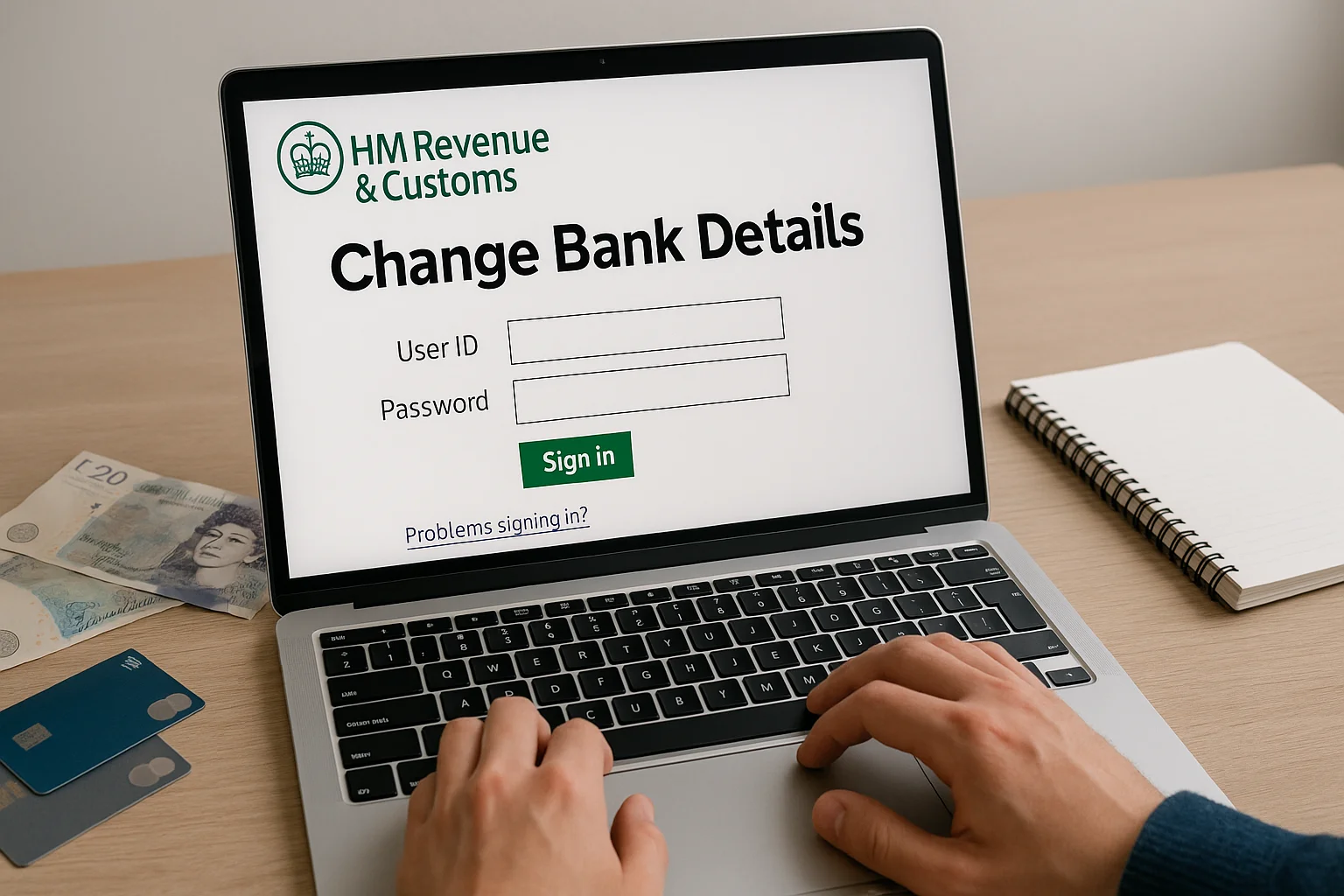
If the bank, building society or account receiving your Child Benefit has changed, you should update HM Revenue and Customs as soon as possible. This is particularly important if you have switched banks, closed an old account, moved to a joint account or want payments directed to another suitable account.
HMRC currently directs Child Benefit claimants to update bank or building society details through its online service or the official HMRC app. Only the person who claims Child Benefit can report the change.
Keeping your payment details accurate reduces the risk of a payment being delayed or sent to an account you no longer use.
What Is the Quickest Way to Change Child Benefit Bank Details?
The most direct option is HMRC’s secure Child Benefit bank-detail service.
You can sign in using your existing HMRC sign-in details. If you do not already have sign-in details, HMRC says you can create them during the process.
You may also be asked to prove your identity, normally using photo identification such as a passport or driving licence.
The official HMRC app can also be used to manage Child Benefit and update personal details.
Unlike the previous version of this article, it is better not to state that bank details update instantly or in real time. HMRC does not currently promise an immediate processing time for every bank-detail change.
How Do You Change Your Child Benefit Bank Details Online?
Changing the account online is generally the simplest route.
- Open HMRC’s secure Child Benefit bank-detail service.
- Sign in using your HMRC account details or create sign-in details if you do not already have them.
- Complete an identity check if HMRC asks you to prove who you are.
- Follow the Child Benefit prompts for changing your bank or building society details.
- Enter the new account information carefully, including the account number, sort code and any building society roll or reference number requested.
- Review the information before submitting it.
- Keep any acknowledgement or confirmation HMRC provides and check your subsequent Child Benefit payment.
The exact labels shown during the online journey can change, so it is better to follow the current HMRC prompts rather than rely on old screenshots or menu names. HMRC’s current guidance confirms that the online sign-in service and HMRC app are the designated routes for changing bank or building society details.
Online, App, Phone or Post: Which Method Should You Use?
Method Current Position Best For
HMRC Online Service Official route for changing bank or building society details Most claimants wanting to make the change directly
HMRC App Officially supports managing and updating Child Benefit details Claimants who already use the app
Phone HMRC provides the Child Benefit helpline for queries when the answer cannot be found through the app Getting help with a problem or unusual situation
Post Current contact guidance lists post for Child Benefit questions and complaints Situations where HMRC specifically requires written correspondence
The Child Benefit helpline is 0300 200 3100, or +44 161 210 3086 from outside the UK. Current opening hours are Monday to Friday, 8am to 6pm, excluding bank holidays. Check current Child Benefit contact details
The postal address for general Child Benefit questions is:
HM Revenue and Customs – Child Benefit Office
PO Box 1
Newcastle upon Tyne
NE88 1AA
United Kingdom
However, GOV.UK does not currently present posting your bank details to this address as the standard way to change the account. The online service or HMRC app should therefore be the first choice unless HMRC instructs you otherwise.
Who Is Allowed to Change Child Benefit Bank Details?
Only the person who is actually claiming Child Benefit can report changes affecting the claim. A partner cannot simply change the payment details because they live in the same household or share household finances.

This restriction also applies in important situations involving representatives. HMRC guidance on authorised intermediaries states that an intermediary cannot change a claimant’s bank details or address on their behalf.
You should therefore make sure the named Child Benefit claimant is the person completing the update.
Can Child Benefit Be Paid Into a Joint or Building Society Account?
Yes. Child Benefit is not limited to an ordinary sole bank account.
HMRC’s current Child Benefit claim form allows payments to be made into a nominated account capable of receiving direct credit transfers.
It specifically provides options for an account:
Account Type Can It Be Used?
Account in your own name Yes
Joint account Yes
Account in someone else's name HMRC's form provides for this
Building society account Yes, with a roll or reference number where required
Credit union account Benefits can generally be paid into suitable credit union accounts
HMRC’s Child Benefit form specifically recognises accounts held in joint names, while wider GOV.UK benefit-payment guidance states that benefits are normally paid into a bank, building society or credit union account.
This means moving from a sole account to an appropriate joint account is possible. What matters is that the nominated account can receive the payment and that the Child Benefit claimant makes the change.
Can Child Benefit Be Paid Into a Credit Union Account?
Potentially, yes. GOV.UK states that benefits are normally paid into bank, building society or credit union accounts.
Some credit unions also operate arrangements where Child Benefit is paid into a credit union account and an agreed amount is automatically allocated to savings or loan repayments before the remaining money is made available to the member.
These arrangements are products offered by individual credit unions rather than an HMRC Child Benefit feature, so eligibility, borrowing costs and repayment arrangements vary.
For example, some credit unions currently advertise Child Benefit-linked saving and borrowing arrangements where agreed loan repayments are deducted when the benefit arrives.
Always check the credit union’s account details and terms before asking HMRC to redirect your payment.
What Happens After You Submit New Bank Details?
Do not assume that submitting a change means every HMRC system and future payment will update immediately.
HMRC does not publish one fixed processing period that applies to every Child Benefit bank-detail change.
If you have already reported a change and are waiting for it to be dealt with, you can use HMRC’s reply-time checker to see when you should expect a response.
The checker includes Child Benefit requests and is updated regularly by HMRC.
You can also review your bank statement or Child Benefit payment history.
GOV.UK says Child Benefit is normally paid every four weeks and advises people with a missing payment to check the payment date and contact their bank before contacting the Child Benefit Office.
What Other Child Benefit Changes Must You Tell HMRC About?
Updating the receiving account is only one type of change HMRC needs to know about.
You should also report significant changes such as moving home, changing your name, starting to care for another child, changes in your relationship, changes to immigration status or relevant changes in income.
Current GOV.UK guidance also says you should report relevant overseas moves when:
- You intend to go abroad for more than 8 weeks
- You or your partner intend to move abroad for more than one year
- You are a Crown servant leaving the UK for an overseas posting
These thresholds are more useful than simply saying that HMRC needs to know whenever you “move abroad”, because short trips and permanent or extended moves can be treated differently.
What Happens to Child Benefit When Two Families Move In Together?
This is particularly important when two people who already receive Child Benefit form one household.
For the 2026/27 tax year, Child Benefit is:
Child Weekly Rate
Eldest or only child £27.05
Each additional child £17.90
When two Child Benefit claimants move in together, the household can only receive the higher rate for the eldest child in the household.
The two adults can continue claiming Child Benefit for different children, but they cannot both receive the higher eldest-child rate while living together.
If both continue receiving the higher amount incorrectly, HMRC warns that some money may have to be repaid.
This is why a relationship or household change should be reported separately rather than treating it purely as a change of bank account.
Is Your Child Turning 16? Check Their Education Status Too
Updating banking details is important, but parents of teenagers have another deadline that can directly stop Child Benefit payments.
Child Benefit normally stops on 31 August on or after a child’s 16th birthday unless the child remains in qualifying education or training and HMRC has been told where required.
For families dealing with this in 2026, HMRC issued a reminder on 17 August 2026 telling parents whose 16 to 19-year-olds are starting qualifying further education or approved training in September to extend their claim by 31 August 2026.
Parents whose teenager is already partway through a course that has previously been reported to HMRC do not need to update HMRC again simply because September is approaching.
Qualifying full-time non-advanced education can include A levels, T levels, GCSEs, Scottish Highers, NVQs and many vocational qualifications up to level 3.
A standard apprenticeship generally does not qualify, although there are specific exceptions such as Foundation Apprenticeships in Wales.
Families considering vocational routes should therefore check how apprenticeships can affect Child Benefit and other household support before assuming payments will continue.
The definitive eligibility rules are available through GOV.UK’s Child Benefit guidance for 16 to 19-year-olds.
What Are the Current Child Benefit Rates in 2026/27?
The confirmed Child Benefit rates for the 2026/27 tax year are £27.05 per week for the eldest or only child and £17.90 per week for each additional child.
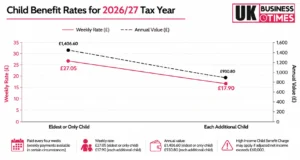
That is worth up to approximately £1,406.60 a year for the eldest or only child and £930.80 a year for each additional child.
Child Benefit is usually paid every four weeks, although weekly payments are available in certain circumstances, including for some single parents and households receiving specified benefits.
If either partner has adjusted net income above £60,000, the higher earner may also become liable for the High Income Child Benefit Charge.
How Can You Keep Your Child Benefit Details Secure?
Always begin a Child Benefit change through GOV.UK, your HMRC account or the official HMRC app rather than following unexpected links in emails or text messages.
Do not share your HMRC sign-in credentials with another person simply because they need access to the household finances.
HMRC may carry out identity verification before allowing sensitive details to be changed, and the bank-detail service itself sits on the secure account.hmrc.gov.uk domain.
If an HMRC letter contains a QR code concerning a teenager’s education status, HMRC says its genuine Child Benefit QR codes direct people to GOV.UK or the HMRC app.
Conclusion
Changing Child Benefit bank details is now primarily an online process. The named claimant should use HMRC’s secure Child Benefit service or the official HMRC app and complete any identity checks requested.
The important point is not to assume that an online submission means the change has been processed instantly. Check subsequent payments and use HMRC’s reply-time service if you are waiting for a response.
It is also worth reviewing the wider claim at the same time.
Moving abroad for an extended period, joining households with another Child Benefit claimant and a teenager continuing education after 16 can all affect how much is paid or whether payments continue.
For parents of 16 to 19-year-olds starting qualifying education or training in September 2026, the 31 August 2026 deadline is particularly important.
FAQs
How Long Does It Take HMRC to Change Child Benefit Bank Details?
HMRC does not currently give one fixed processing time for every bank-detail update. If you are waiting after submitting a change, use HMRC’s reply-time checker rather than assuming the update was immediate.
Can I Change Child Benefit Bank Details Without Existing HMRC Sign-In Details?
Yes. HMRC says you will be able to create sign-in details when using the online service if you do not already have them.
Can My Partner Change My Child Benefit Bank Details?
Not simply because they are your partner. Only the person claiming Child Benefit can report the change, and even an authorised intermediary cannot change bank details on the claimant’s behalf.
Can Child Benefit Be Paid Into a Joint Account?
Yes. HMRC’s Child Benefit claim documentation explicitly allows a nominated account to be held in joint names, provided it can receive the payment.
Can Child Benefit Be Paid Into a Building Society or Credit Union?
Yes. HMRC specifically accommodates building society accounts, while GOV.UK’s benefit-payment guidance also recognises suitable credit union accounts.
Can I Use Child Benefit to Repay a Credit Union Loan?
Some credit unions offer accounts where Child Benefit is paid in and agreed loan or savings deductions are made automatically. This is an arrangement with the individual credit union rather than an HMRC loan scheme.
Do I Need to Update HMRC When My Child Turns 16?
If your child is continuing in qualifying education or approved training, HMRC may need confirmation so Child Benefit can continue. For teenagers starting a new qualifying course in September 2026, the current deadline is 31 August 2026.
What Happens if Two Child Benefit Claimants Move In Together?
Only the eldest child in the combined household can attract the higher Child Benefit rate. If both adults continue receiving the higher rate, HMRC may require an overpayment to be repaid.