

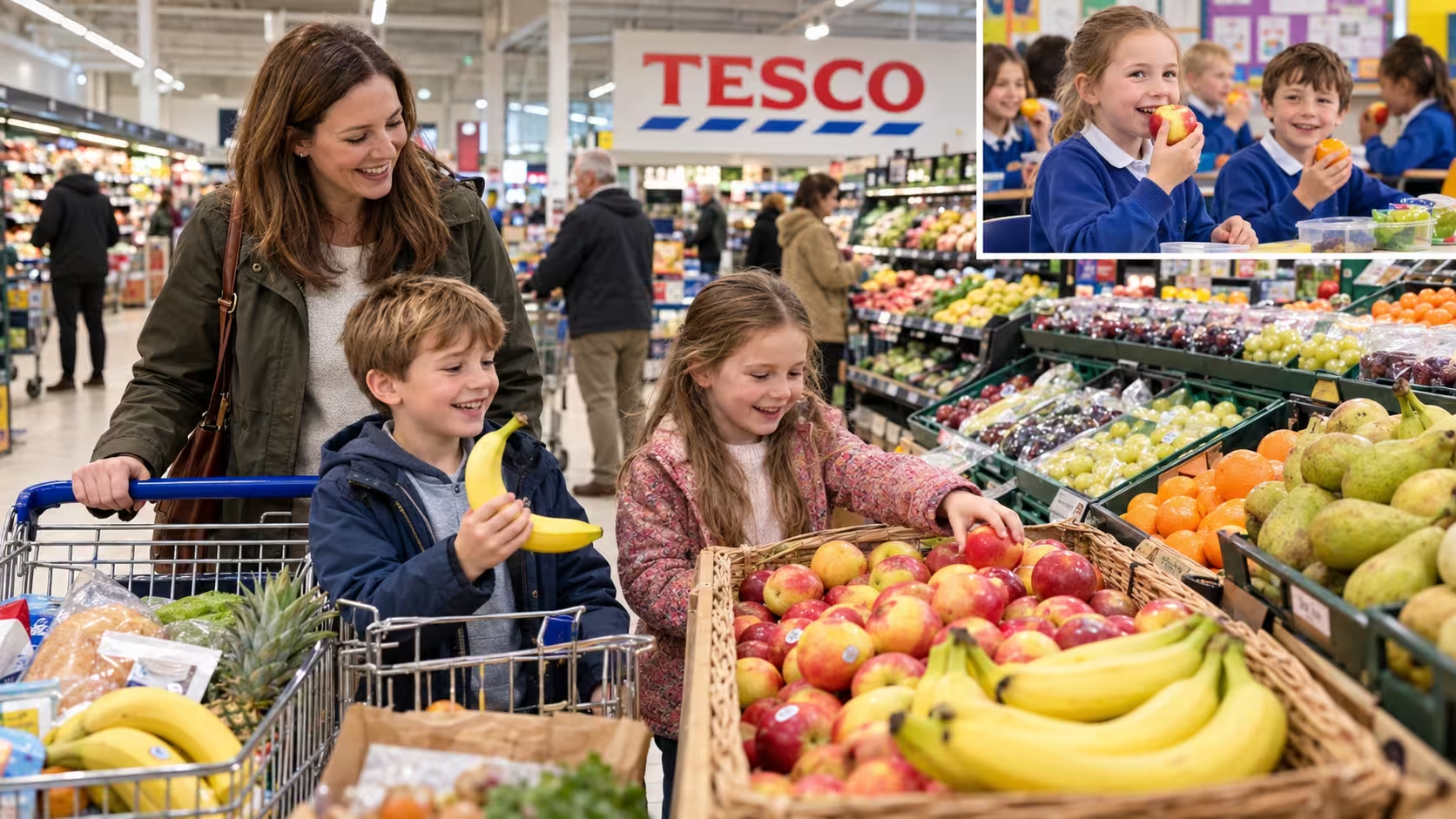
Tesco Free Fruit now covers more than one initiative for children in the UK.
The supermarket provides free fruit to children in stores during selected school-holiday periods, while its larger Free Fruit & Veg for Schools programme funds fresh produce for pupils during the school day.
The school programme has grown substantially since it began in 2024.
Tesco’s latest figures show that almost 20 million portions of fruit and vegetables have been eaten through the scheme, more than 186,000 children have already been reached and support has expanded to over 1,000 UK schools.
This means “Tesco Free Fruit” is no longer simply a short supermarket giveaway.
It now forms part of a broader programme designed to improve children’s access to fruit and vegetables both during term time and during school holidays.
Is Tesco Still Giving Away Free Fruit?
Yes, Tesco is continuing its free fruit initiatives, although availability depends on which programme you mean.
For its Free Fruit for Kids offer, Tesco provided free fruit in stores from 27 April to 31 May 2026 and said the initiative would continue during school holidays for the remainder of 2026, excluding December.
Children can receive fruit while shopping with their parents or carers during participating periods.
This means free fruit should not be treated as a permanent everyday offer in every Tesco store. Parents should consider the school-holiday timing and local availability before making a special journey.
The in-store programme is separate from Tesco’s Clubcard loyalty scheme.
Customers who want to use Tesco’s wider loyalty benefits can separately find information on how to get a Tesco Clubcard by post, but the Free Fruit for Kids initiative is presented by Tesco as a children’s healthy-eating programme rather than a Clubcard promotion.
The larger Free Fruit & Veg for Schools programme operates differently. It provides funding to participating schools so children can regularly access fresh produce during the school day.
Tesco says the programme now reaches more than 1,000 schools.
What Is The Tesco Free Fruit Scheme?
There are two main Tesco free fruit initiatives that parents may come across.
Tesco Free Fruit For Kids
Free Fruit for Kids is the in-store part of Tesco’s programme. It is intended to give children a healthier snack while they are shopping with a parent or carer during participating school-holiday periods.
Tesco says the programme is intended to help families when children are away from school, a time when their normal routines and access to food provided through school may change.
School holidays can create additional food, childcare and activity costs for households.
Families looking at the wider financial pressures associated with these periods may also be interested in the support available to reduce school-holiday family costs.
Tesco Free Fruit And Veg For Schools
The school programme is much larger and operates throughout participating schools rather than through a child collecting fruit at a supermarket checkout.
Tesco launched the programme in 2024 in partnership with the British Nutrition Foundation. Groundwork UK is also involved in Tesco’s current community programme.
Instead of supplying every school with an identical box of produce,
Tesco provides participating schools with funding to purchase fruit and vegetables. This allows schools to incorporate fresh produce into their own routines and respond to what their pupils will actually eat.
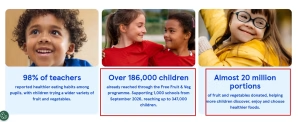
Tesco’s official programme page confirms that Free Fruit & Veg for Schools now supports over 1,000 schools, has reached more than 186,000 children and has provided almost 20 million portions.
How Does Tesco Free Fruit And Veg For Schools Work?
Tesco provides funding that allows selected schools to buy fresh fruit and vegetables, helping pupils access healthy food as part of the school day.
Schools can decide how the produce fits into their normal activities.
In some schools, children receive fruit as a regular snack. Others use the funding for cooking, food education or activities designed to encourage children to try unfamiliar foods.
Tesco has highlighted examples where pupils are involved in choosing, buying and distributing produce themselves.
At Boldon School in South Tyneside, for example, children took part in selecting and sharing fruit and vegetables, while Tesco says pupils consumed 14,778 portions during the school’s first year on the programme.
The scheme therefore goes beyond simply handing children one piece of fruit. Schools can use the programme to:
- Provide Regular Healthy Snacks: Pupils can access fruit and vegetables during the school day
- Introduce New Foods: Children can try produce they may not normally have at home
- Support Food Education: Schools can use fruit and vegetables during cooking or classroom activities
- Encourage Independence: Pupils can become involved in choosing and preparing food
- Reduce Hunger During School: Regular snacks may help pupils who arrive at school without having eaten enough
The programme is particularly relevant at a time when some households are facing pressure from food and other essential costs.
Families checking what other help may be available can also review UK support including free school meals and Healthy Start.
Which Schools And Children Can Benefit?
The Free Fruit & Veg for Schools programme is not an automatic entitlement for every UK school or every child.
Tesco has focused the scheme on schools in communities where access to healthy food can be more difficult.
For the 2025/26 academic year, Tesco said its additional funding was specifically targeted towards areas where more than 50% of pupils received free school meals.
The programme has since expanded to more than 1,000 schools. Tesco describes its current focus as reaching children in some of the UK’s most challenged communities.
Parents do not individually register their child for the main school programme. Participation depends on whether their school is included.
This also means receiving free school meals does not automatically mean a pupil’s school participates in Tesco Free Fruit & Veg for Schools. The two forms of support are separate.
Households concerned about wider living costs should therefore check all support they may qualify for rather than relying on one programme.
There are separate updates covering the position on the UK cost of living payment in 2026 and other forms of household assistance.
How Much Fruit Has Tesco Given Away So Far?
The scale of the school programme has increased considerably since its launch.
According to Tesco’s October 2026 update, children taking part during the programme’s first two years consumed almost 20 million portions of fruit and vegetables.
Tesco said the scheme had reached up to 186,000 pupils, while participating children ate around 60 portions each on average during that period.
Measure Latest Reported Position
Fruit And Vegetable Portions Almost 20 Million
Children Already Reached More Than 186,000
Schools Supported Over 1,000
Types Of Fruit And Vegetables Tried 103
Average Portions Per Participating Pupil Around 60
Tesco’s programme page also says the expansion to 1,000 schools from September 2026 could reach up to 347,000 children.
These newer figures are important because the programme is now substantially larger than it was during its first year.
What Fruit And Vegetables Are Children Receiving?
Children are not restricted to apples or another single type of fruit.
Tesco reported that pupils had eaten 103 different types of fruit and vegetables through the programme by October 2026.
Children have been able to try everyday favourites as well as foods that may be less common in some household shopping baskets.
Examples highlighted through Tesco’s programme include:
- Popular Fruits: Apples, bananas, oranges, grapes and kiwi
- Popular Vegetables: Carrots, potatoes and other everyday vegetables
- Less Familiar Options: Blueberries, watermelon and asparagus
- School-Led Choices: Produce can vary depending on what an individual school purchases
This variety is significant because one aim of the programme is to make children more confident about trying different foods rather than simply increasing the quantity of one particular fruit.
Tesco’s current programme page says 98% of teachers reported healthier eating habits among pupils, including children trying a wider range of fruit and vegetables.
What Impact Has The Scheme Had On Children?
Tesco’s latest findings suggest the programme may be having an effect beyond the number of portions distributed.
In October 2026, Tesco reported an average 4.2% increase in vitamin C intake among children in the latest year of the programme.
It also said 94% of teachers reported improvements in behaviour, including better focus and increased energy in the classroom.
The programme may be particularly useful for children who arrive at school hungry or have limited opportunities to try different fresh foods at home.
Schools featured by Tesco have also described using the scheme as part of wider learning.
At Twerton Nursery and Infant School in Bath, for example, shared snack times have been used to encourage pupils to talk about flavours and try new foods together.
Bryn Awel Primary School in Caerphilly has incorporated fruit and vegetables into cooking workshops that also support reading, measuring and other classroom skills.
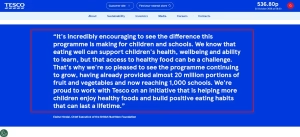
Tesco’s 1 October 2026 update confirms almost 20 million portions, 103 types of fruit and vegetables and reports that 94% of teachers saw improved behaviour among participating pupils.
Can Schools Get Tesco Fruit And Veg Grants?
Yes. Tesco operates a separate Fruit & Veg Grants programme alongside the main Free Fruit & Veg for Schools scheme.
Schools, registered charities and eligible not-for-profit organisations supporting children can apply for grants of up to £1,500 to improve children’s access to fruit and vegetables.
Funding can support projects that make healthy food more accessible or help children become more interested in it.
Tesco gives examples such as activities involving nutritious food, learning how fruit and vegetables grow and practical food sessions.
This is useful for organisations that are not already part of the main school scheme because it provides another possible route to Tesco community funding.
Tesco says almost eight in ten schools are using some of their own limited budgets to provide healthy food for pupils, which is one reason the grant programme has been introduced alongside the wider school initiative.
Can Parents Nominate Their Child’s School?
Parents and other Tesco customers can help bring local schools and children’s projects to Tesco’s attention.
Tesco says customers and colleagues can nominate schools, local projects and community groups that help children and young people access fruit and vegetables. Eligible organisations can then apply through the grant programme.
Customers can also participate through Tesco’s blue-token community voting system.
However, nominating a school for community funding is different from enrolling it directly in the main Free Fruit & Veg for Schools programme.
Parents should not assume that submitting a nomination automatically places their child’s school among the 1,000-plus schools currently receiving programme funding.
For families managing several forms of support at the same time, local grants may sit alongside government or council assistance.
The range of financial help available to UK households can differ according to income, benefits, children’s ages and where a family lives.
How Is Tesco Funding The Free Fruit Programme?
Tesco has used several funding routes to expand its fruit and vegetable initiatives.
During its You Buy, We Give campaign from 7 September to 4 October 2026, Tesco committed to donating 1p for every qualifying fresh fruit, vegetable or salad product sold in UK Tesco stores and on Tesco.com, up to a maximum contribution of £2.3 million.
That particular campaign has now ended, so shoppers should not assume current purchases still trigger the same donation.
Tesco has also connected the programme with:
- Blue Token Funding: Customers can vote for selected local schools and children’s projects
- Community Grants: Eligible organisations can apply for funding of up to £1,500
- WSL Football Partnership: Match attendance contributes towards funding for the schools programme
- Tesco Community Programmes: Wider community funding supports children’s access to food and activities
Under Tesco’s partnership with WSL Football, 10p for each person attending a Barclays WSL or WSL2 match during the season is donated through Groundwork to support the Free Fruit & Veg for Schools programme.
How Is Tesco Expanding The Free Fruit Programme?
Tesco’s longer-term target is much bigger than its current 1,000-school network.
The supermarket says it wants to help one million schoolchildren access free fruit and vegetables through its school and community programmes.
The programme has already expanded rapidly. It started with hundreds of schools in 2024, grew further during the 2025/26 academic year and reached more than 1,000 schools in 2026.
At the same time, Tesco is trying to cover periods when children are not in school through Free Fruit for Kids in stores during school holidays.
That distinction matters for parents. School-based fruit can support children during term time, while the supermarket programme is intended to offer another source of free fruit when normal school routines stop.
December was excluded from Tesco’s announced 2026 Free Fruit for Kids schedule.
Families planning supermarket trips over the Christmas period should therefore treat free-fruit availability separately from general festive trading hours, which can also change.
Current information on which supermarkets are open on Boxing Day can help when planning seasonal shopping.
Conclusion
Tesco Free Fruit has developed from a straightforward children’s fruit giveaway into a much broader programme covering schools, supermarket visits, community grants and partnerships.
The most significant part is now Tesco Free Fruit & Veg for Schools, which supports more than 1,000 schools and has already reached more than 186,000 children.
Almost 20 million portions have been consumed through the programme, with pupils trying 103 types of fruit and vegetables.
For parents, the key point is to distinguish between the schemes.
Free Fruit for Kids operates in Tesco stores during participating school-holiday periods, while the school programme depends on whether a child’s school has been selected for support.
Schools and eligible children’s organisations that are not already taking part may also have opportunities through Tesco’s Fruit & Veg Grants programme, while customers can nominate local projects and participate in community voting.
With Tesco aiming ultimately to help one million children access free fruit and vegetables, the programme is set to extend well beyond the original short-term giveaways.
Frequently Asked Questions
Is Tesco Free Fruit Available In Every Store?
Not necessarily. Tesco says Free Fruit for Kids operates during participating school-holiday periods, so parents should not assume fruit is continuously available in every branch throughout the year.
Do Parents Need To Make A Purchase?
Tesco presents Free Fruit for Kids as an initiative for children shopping with parents or carers rather than as a standard product promotion. Availability should still be checked with the participating store.
Can Any School Join The Tesco Free Fruit Scheme?
No. The main programme targets selected schools, particularly in communities where access to healthy food is more challenging. Tesco has expanded it to more than 1,000 schools.
Can Parents Apply For The School Scheme?
Parents cannot directly enrol an individual child in the main school programme. They can, however, nominate eligible local schools and children’s projects for Tesco community support.
How Much Fruit Has Tesco Given To Schools?
Tesco reported in October 2026 that almost 20 million portions of fruit and vegetables had been eaten through the programme during its first two years.
What Fruit And Vegetables Are Included?
The selection varies by school. Tesco says children have tried 103 different types of fruit and vegetables, ranging from familiar choices such as apples and carrots to foods including blueberries, watermelon and asparagus.
Will Tesco Free Fruit Continue Beyond 2026?
Tesco has not presented the wider programme as ending in 2026. Its long-term ambition is to help one million children access free fruit and vegetables through school and community programmes, indicating continued expansion rather than a one-off campaign.